 (2).png)

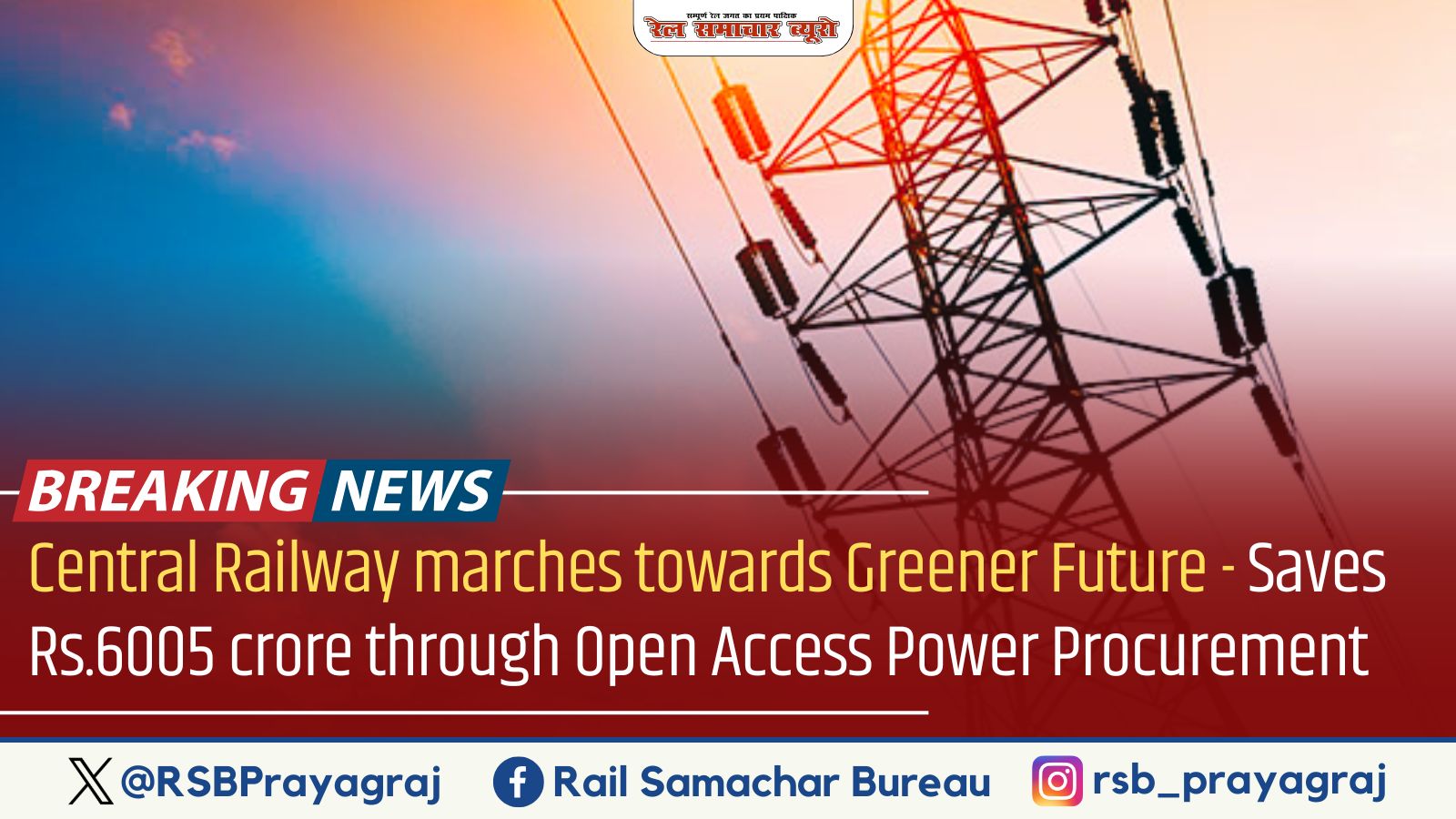
Central Railway has played an important role in promoting the use of green energy for its power requirements.
Central Railway pioneered the concept of power procurement through the Open Access method on Indian Railways. Previously, Indian Railways met its power requirements at high tariffs from State Electricity Boards or from DISCOMS (Distribution Companies).
To reduce expenditure over time, Indian Railways adopted various strategies, one of which was Open Access. This allows direct power purchase from cheaper sources such as power exchanges, generators, or bilateral agreements, leading to reduced costs.
Central Railway was the first zone on Indian Railways to procure power through Open Access in 2015, ensuring a total saving of Rs.6005.42 crore from 2015-16 to the present. The savings started with Rs.161.20 crore in 2015-16 and have grown to Rs.690.47 crore in 2024-25.
These savings have been derived by comparing the actual power procurement cost under Open Access with the previous procurement cost of Rs.8.69 per kWh (kilowatt-hour).
Key Benefits of Open Access:
- Cost Reduction: The shift to Open Access has significantly lowered the per unit cost of power.
- Flexibility in Procurement: Open Access enables procurement from different sources, ensuring cost optimization.
- Market-Based Pricing Advantage: Purchasing power from energy exchanges at competitive market rates, instead of fixed tariffs, has led to substantial savings.
- Increased Reliability due to multiple sources.
- Reduced Dependence on one particular source.
Indian Railways is working in mission mode to become the largest green railway in the world, steadily moving towards becoming a “net-zero carbon emitter” by 2030, and Central Railway is playing an important role in achieving this goal.
Source/CR
_page-0001.jpg)