 (2).png)

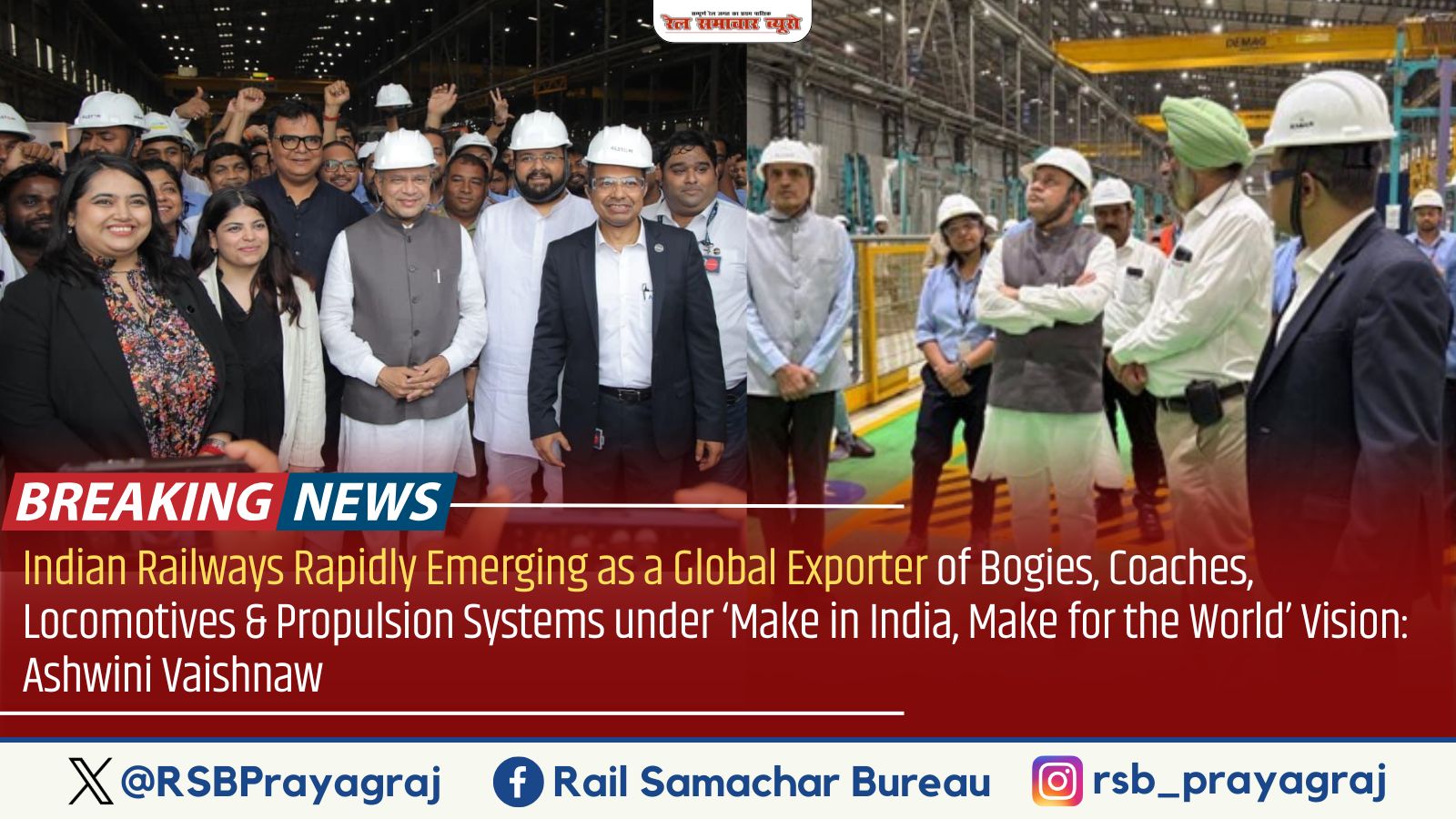
- Alstom Drives ‘Make in India’ with World-Class Manufacturing and Exports
- Minister Applauds Alstom’s Role in Building India’s Global Rail Footprint
Union Minister for Railways, Shri Ashwini Vaishnaw, visited Alstom’s Savli facility in Vadodara, Gujarat — a key manufacturing hub for railway rolling stock in India. During his visit, the Minister reviewed the facility’s operations with a specific focus on maintenance practices and appreciated Alstom’s approach of designing customized solutions for each order. He noted that such innovative practices could be emulated by Indian Railways to enhance efficiency.
In a significant move toward academic-industry collaboration, the Minister proposed developing a joint training programme between Alstom and Gati Shakti Vishwavidyalaya through a creative and collaborative framework. He also suggested that General Managers of all Production Units undertake training and exposure visits to the Savli facility. Discussions further included the potential use of sensors and artificial intelligence for preventive maintenance in railway systems.
The Savli unit is currently engaged in the production of state-of-the-art commuter and transit train cars, fully aligned with the Government of India’s Make in India and Aatmanirbhar Bharat initiatives. The facility exemplifies India’s growing capabilities in advanced manufacturing and innovation, with over 3,400 Indian engineers working in collaboration with 21 Alstom sites globally.
Since 2016, India has successfully exported 1,002 rail cars for international projects. Of these, 450 rail cars manufactured at the Savli unit were exported to Australia for the Queensland Metro project, underscoring India’s role as a trusted global supplier of modern rail systems.
Expanding Global Footprint of Indian Rail Components
The Savli facility has also exported more than 3,800 bogies to countries including Germany, Egypt, Sweden, Australia, and Brazil, along with over 4,000 flatpacks (modular components) to Vienna, Austria. In addition, Alstom’s Maneja unit has exported over 5,000 propulsion systems to various global railway projects.
Designed in India, Installed Worldwide
India is currently leading 27 international signalling projects while supporting an additional 40 globally. The Digital Experience Centre in Bengaluru is driving innovation by supporting over 120 global projects, focusing on next-generation signalling technologies such as IoT, AI, blockchain, and cybersecurity.
“Design, Develop, and Deliver from India to the World”
India’s rail manufacturing and export portfolio continues to grow:
- Metro Coaches exported to Australia and Canada
- Bogies shipped to the UK, Saudi Arabia, France, and Australia
- Propulsion Systems supplied to France, Mexico, Romania, Spain, Germany, and Italy
- Passenger Coaches delivered to Mozambique, Bangladesh, and Sri Lanka
- Locomotives exported to Mozambique, Senegal, Sri Lanka, Myanmar, Bangladesh, and the Republic of Guinea
Boosting Local Industry and Employment
The Savli manufacturing ecosystem is supported by a robust supplier network, including companies such as Integra, Anovi, Hind Rectifier, Hitachi Energy, and ABB — all contributing in areas such as fabrication, interiors, and electrical systems.
Speaking to the media, the Union Minister stated that the positive impact of the Make in India and Make for the World initiatives is clearly visible in the Indian Railways manufacturing sector. He emphasized that exports of railway components are generating significant employment opportunities and enabling Indian engineers and workers to acquire global-level expertise — a major achievement for the Make in India mission.
Source/PIB
_page-0001.jpg)